
I Was Horrified By What A Teacher Asked My Daughter To Do. His Response To Me Was Just As Disturbing.
My kids saw me work out, but I kept the emphasis on being strong and using fitness to help me deal with stress. I never said degrading things about my body, never weighed myself except at doctor visits, and never demonized food in front of them.
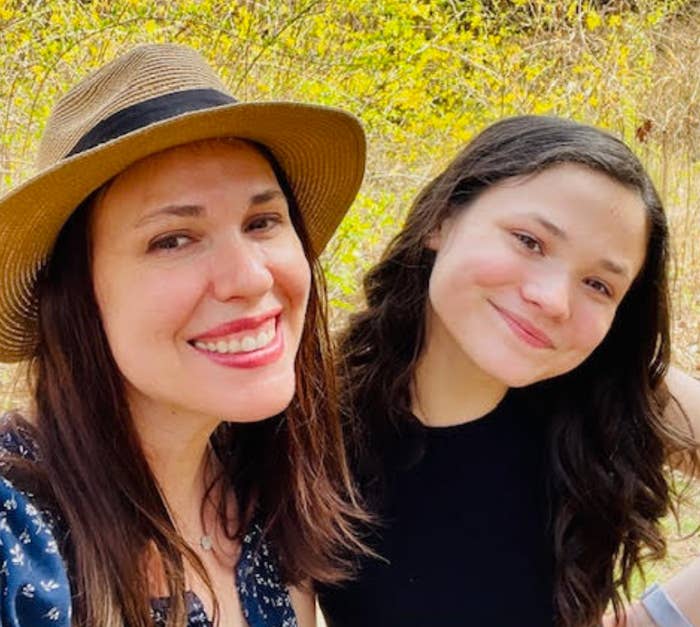
Two people smiling outdoors, one in a straw hat and floral dress, the other in a black sleeveless top. They appear happy, surrounded by foliage
Courtesy of Joy Nicholas
The author and her daughter Lilly.
In Sleeping Beauty, Aurora’s parents destroy all the spindles in the kingdom after the evil fairy Maleficent says the princess will prick her finger on one and die — yet she still manages to find one. Aurora is drawn to it, though it’s locked away in a tower, as if her demise is inevitable. What I didn’t know then, but research is now proving, is that eating disorders may also be genetic, so, despite all my efforts, I watched a perfect storm headed straight for my daughter.
Over the course of a year, during the pandemic, we moved twice, and the second time we found ourselves living abroad.
Lilly attended a prestigious international school where she was bullied by her classmates whenever she asked questions and ridiculed for not already knowing the answers. Worse still, the girls who sat with Lilly at lunch threw out their meals after just a bite or two and acted horrified if she ate everything on her plate.
I thought my daughter was different from me — less sensitive and more resilient — and that she would be able to handle what was happening. She had an effervescent personality and made friends wherever she went. Her uncle once joked that if it was possible to distill the essence of Lilly and distribute it to the world, there would be no need for antidepressants any more. Not only that, she was impressively strong and seemed to excel at whatever sport she tried.
Instead, she began to crack under the pressure. One day, she found a calorie tracker online, unbeknownst to me, and stopped eating almost entirely. Her weight plummeted. It was terrifying for me to witness. She acknowledged her need for help, and though her struggle seemed hopeless, Lilly eventually fought her way back to health.
We moved again, and the social environment at her new school was relaxed and friendly. She seemed happy and at peace, and I felt myself breathing deep sighs of relief — until she told me about the food journal and calorie tracking assignment.
“Lilly,” I said gently, after she told me about her health class struggles, “we have to say something.” She paused, thinking for a moment, then nodded her head in agreement.
First I sent the health teacher an email explaining why I was concerned and asking if we could exempt Lilly from the assignment or alter it to remove the tracker. I addressed his comment about eating 1,000 calories, since that isn’t enough to even maintain weight, and offered to speak to his classes about eating disorders. He responded by saying that he didn’t teach that material in his class, and of course he didn’t mean what he had said, but there was no way that he would change the assignment for Lilly or anyone.
I sent another email, fully aware I was quickly becoming That Mom. However, it was now about more than me wanting to protect just my daughter. In the absence of a holistic approach that included education about eating disorders, I was looking out for all of the kids who might not recognize a calorie tracker as the loaded gun it was and could, before they knew it, find themselves in the same trap that Lilly and I had once been in. I filled my follow-up email with links to articles on the relationship between calorie tracking and eating disorders, and then I hit “send.” I didn’t receive a reply.
In light of how recent Lilly’s recovery was and how delicate it still seemed, I decided to withdraw her from the class. Her guidance counselor, also a parent, was supportive and equally concerned about this teacher’s curriculum.
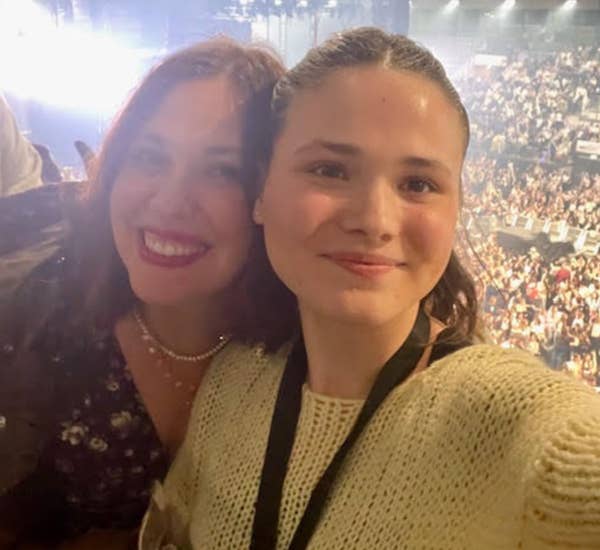
Two people smiling at a concert with a large crowd visible in the background
Courtesy of Joy Nicholas
"I'm deeply grateful for my close relationship with my daughter and the mutual trust to share true feelings — even hard ones," the author writes.
Calorie trackers have no place in middle or high school health classes. They teach us to look at our food consumption like a scorecard and judge whether we did terrible, OK, or excellent. Teenagers’ prefrontal cortices are still developing, already making them more susceptible to social pressures and mental health issues, and assignments like these compound that risk. Although teens might find calorie trackers on their own, as Lilly did, using them in school assignments pushes them into a vulnerable — and potentially dangerous — position.
There are better ways to present nutritive eating to kids and to talk about what food does for us. Health educators need to address the many forms of eating disorders that affect millions of people every year. Emphasizing how social media distorts reality is also essential.
Lilly still needs to take a health class to complete her graduation requirements, and I know her next teacher might take the same approach as her last one. What then? my inner mama bear wonders, with no small amount of trepidation. Even though I hate that we both went through the same darkness of an eating disorder, I’m so thankful for our close relationship and that Lilly knows she can come to me with her struggles.
I’m having to learn yet again that there’s so much I cannot control, which means I can’t guarantee my kids won’t face challenges, but I can still try to protect them — and their friends and peers — from unnecessary peril.